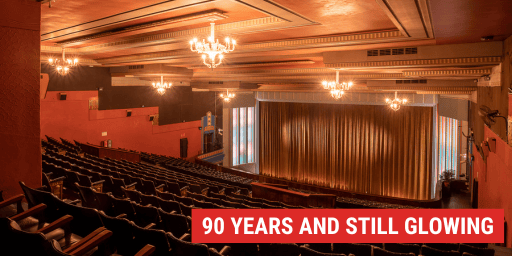
The heritage-listed cinema first opened its doors on 3 April 1936, and remains Melbourne’s oldest operating single‑screen theatre, drawing generations of filmgoers to the corner of Chapel Street and Dandenong Road.
Over nine decades, the Astor has survived wartime restrictions, the rise of television, multiplex competition and repeated development threats, securing its place as a treasured local landmark.
The anniversary follows international recognition in March 2025, when the Astor was named seventh in the world in Time Out’s list of the 50 most beautiful cinemas globally.
The ranking placed the St Kilda favourite alongside some of cinema’s most celebrated venues, including Le Grand Rex in Paris, which was ranked number one, and Pathé Tuschinski in Amsterdam, which took second place.
Time Out praised the Astor for its preserved Art Deco interiors, vast auditorium, sweeping curtains and old‑Hollywood atmosphere, noting its rare ability to balance architectural heritage with an active and diverse screening program. The venue is also renowned for its double features, repertory programming and commitment to screening film in formats such as 35mm and 70mm.
The Astor’s survival was cemented in 1998 with heritage protection, and its future secured again in 2015 when Palace Cinemas took over stewardship of the building, committing to retain it as a single‑screen cinema.
As it enters its tenth decade, the Astor Theatre stands as both a St Kilda institution and a cinema of global significance, proving that neighbourhood icons can still command international admiration.
Time Out’s full rankings on the most beautiful movie theaters in the world were:
1. Le Grand Rex, Paris
2. Pathé Tuschinski, Amsterdam
3. Village East Cinema, New York
4. Cineteca Madrid, Madrid
5. The Electric, London
6. Cinema Dei Piccoli, Rome
7. The Astor, Melbourne
8. Puskin Art Cinema, Budapest
9. Cine Doré Filmoteca Española, Madrid
10. Le Champo, Paris
11. The Raj Mandir, Jaipur
12. The Labia Theatre, Cape Town
13. Rio Cinema, London
14. Stella Cinema, Dublin
15. TCL Chinese Theatre, Los Angeles
16. The Little Prince Micro-Cinema, Ontario
17. Cineteca Nacional de Mexico, Mexico City
18. New Beverly Cinema, Los Angeles
19. The Park Theatre, Manitoba
20. Stadtkino, Vienna
21. Sala Equis, Madrid
22. Hayden Orpheum Picture Palace, Sydney
23. Orinda Theatre, California
24. Mareel, Shetland Islands
25. Studio 28, Paris
26. Music Box Theatre, Chicago
27. Cinema Le Cosmos, Strasbourg
28. Coolidge Corner Theatre, Massachusetts
29. Metrograph, New York City
30. Le Colisée, Carcassonne
31. Phenomena Experience, Barcelona
32. BFI Southbank, London
33. Plaza Theatre, Atlanta
34. Avalon Theater, California
35. Egyptian Theatre, Los Angeles
36. Golden Age Cinema and Bar, Sydney
37. Le Cinéma du Panthéon, Paris
38. Museum Lichtspiele, Munich
39. Genesis Cinema, London
40. Grand Teatret, Copenhagen
41. The Sun Theatre, Melbourne
42. Paris Theater, New York
43. Everyman, Bath
44. Curzon Bloomsbury, London
45. The Projector, Singapore
46. Cinémathèque de Tanger, Tangier
47. Busan Cinema Center, Busan
48. Cinema São Jorge, Lisbon
49. Broadway Cinematheque, Hong Kong
50. Grand Lake Theatre, Oakland
TWiSK family anecdote
Greg Day’s late mother always associated The Astor with this pre-war ditty spiced up with risky double entendres.