The Formula 1 circus has left town, but, in Albert Park’s beautiful sparkling lake the avian botulism crisis rages on.
The Botulism Count is rising
Park users gained a glimpse back inside Albert Park’s razor wire fences last week, confirming their worst fears. ‘In just my first few minutes back in the reopened section of park, I found two bodies,’ says Annabelle Bueman, a local birder. ‘One was a Pacific Black Duck and the other was a Little Pied Cormorant’.
The park’s bird death count is now close to 1300, well and truly ranking among Australia’s worst avian botulism outbreaks.
Most of the local waterbird species have been affected over the past 15 months, including black swans and ducks. The overwhelming majority have been ibises, those loud little Aussie natives that are often described as bin chickens.
935 of the 1289 dead birds collected so far have been ibises. And the vast majority of them were found on Gunn Island.
Cathy Maguire, who runs the ‘Birds of Albert Park Lake’ Facebook group, hates the bin chicken tag. ‘It’s an unfair dismissal of a clever, ancient survivor that’s simply doing its best to adapt to a world we changed,’ she says.
The ibis colony at Albert Park is made up of ‘refugees’ who’ve lost habitat in other areas.
In northern Australia, ibises have found a way of flicking and washing the toxins from cane toads. Sadly, they haven’t yet found a way around the avian botulism at Albert Park Lake.
Are the Ibises to blame?
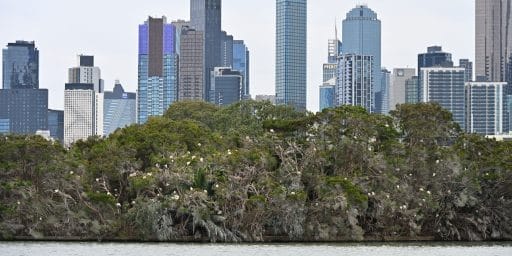
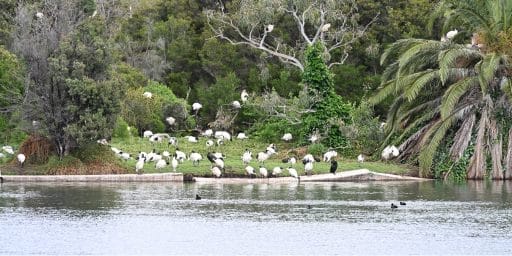
The ibises arrived here in 2024, quickly transforming Gunn Island to a giant, noisy nesting spot in just a few months. When the botulism arrived the following summer, many park users started to wonder if the ibises might have been to blame in some way.
‘I haven’t seen any evidence that the ibises brought the botulism here,’ says Dr Kim Lowe, Adjunct Senior Research Fellow with La Trobe University.
‘There are large populations of ibis at Jells Park, Broadmeadows and Coburg without botulism.’
‘The Department of Agriculture says that botulism is widespread in wetland soils and can be hosted in living fish,’ Dr Lowe explains, as he offers an alternative theory. ‘If the fish die, birds like ibis may feed on the carcasses and may be infected.’
Dr Lowe also wonders whether many of the deceased birds have been incorrectly counted in the botulism tally. He points out that nestling and fledgling ibises have high death rates in all of the breeding colonies that have been studied.
Sierra’s survival story…
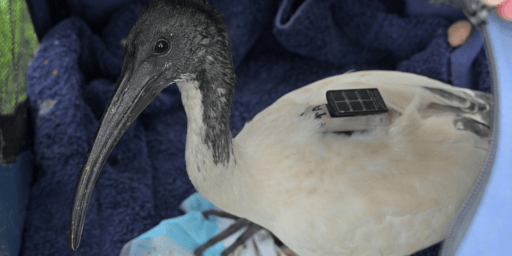
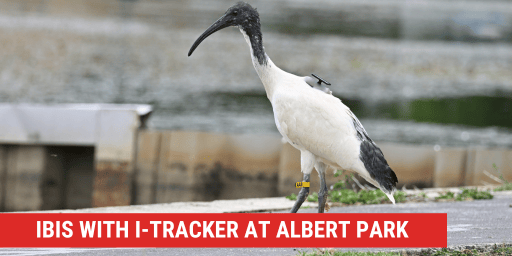
One young ibis, dubbed Sierra, is providing Dr Lowe and bird fans with some interesting data and also a much-needed dose of optimism for botulism survival.
She was rescued from the lake by Parks Victoria rangers in late January. They knew that survival rates had been depressingly low so far, but they called for help anyway from Melbourne Zoo’s Marine Response Unit.
After a week in care at the zoo, and three more weeks at the Boobook Wildlife Shelter, Sierra was released back at the lake a fortnight ago.
She rejoined the colony with a tracking device, monitored by Dr Lowe. And Sierra’s special little backpack has produced a lovely story of resilience.
At the start of GP weekend, hundreds of ibises left Albert Park. Little Sierra was among them, flying a remarkable 40 kilometres in one day to Cranbourne, Hampton Park and Narre Warren.
Not a bad effort for a young bird who’d been so sick for so long.
Now, we just hope this one survival story can lead to an equally uplifting sequel for Sierra’s wider family, and for the other birds at Albert Park.
Kelly Brennan is the Convenor of Lake ALIVE! which is an advocacy group for Albert Park recreational users and also provides a voice for the local wildlife.