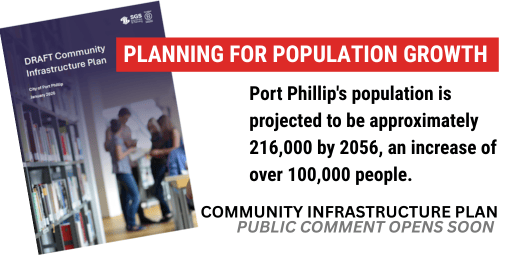
Port Phillip City Council has released its draft Community Infrastructure Plan (CIP), a strategic blueprint designed to meet the evolving needs of its growing and changing population over the next 25 years. The plan aims to guide short, medium, and long-term decisions regarding community facilities.
The Community Infrastructure Plan (CIP) is not a delivery plan for Council projects but rather a high-level view to inform advocacy, partnerships, and engagement with infrastructure users. It focuses on essential community infrastructure such as early years facilities, libraries, arts and cultural venues, community centres, and maternal child health facilities. Notably, recreation and sports facilities are out of scope, to be addressed in a separate Sport and Recreation Strategy.
A key driver for the plan is the anticipated significant population growth in areas like Fishermans Bend and Lakeside, which currently have minimal community infrastructure. The CIP emphasises a coordinated, collaborative, and strategic approach, integrating advocacy, partnerships, and practical opportunities within existing Council cycles to maximize community benefit.
The plan’s vision is “A network of high-performing community infrastructure that supports the wellbeing and connectedness of our diverse community and reinforces Port Phillip as a thriving cultural hub and great place to live.” This vision is underpinned by principles of flexibility, high quality, accessibility, equity, co-location, and financial sustainability.
Next steps involve a second phase of community engagement from March 23 to May 5, including a “Have Your Say” survey and qualitative interviews. Following this, the CIP will be finalized and presented for endorsement by June 30, 2026.
Population Predictions
Port Phillip’s population is projected to reach approximately 216,000 people by 2056, an increase from the current 112,000 residents. This growth will not be evenly distributed across the municipality.
The primary driver of this population increase will be the redevelopment of Fishermans Bend, transforming its formerly industrial areas into residential and commercial communities. Specifically, the Fishermans Bend precincts of Sandridge and Montague are expected to experience significant growth.
While central and southern local areas, which are more established, will see incremental growth, the Fishermans Bend precincts, along with Port Melbourne and South Melbourne, are predicted to have a high concentration of residents aged 10-19 years by 2056. The Sandridge and Montague precincts of Fishermans Bend are also expected to have 31% of the 30-44 age group and 34% of the 0-9 age group. In contrast, the three St Kilda local areas will see 35% of the 20-29 age group, and Albert Park and Port Melbourne will have 27% of the 50-74 age group, with Albert Park and St Kilda West having 37% of the 75-85+ age group.
Link to draft Plan PDF
Link to Have Your Say page