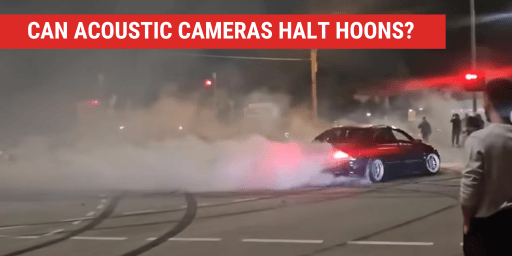
The Grand Prix may be a worldwide event, but racing in the streets of St Kilda and Port Melbourne is a year‑round Hoon Prix.
Spurred on by the good burghers of not-so-sleepy Beacon Cove, Cr Heather Cunsolo brought a motion calling for Council to request that the State Government trial acoustic noise cameras to deter hoons.
Cunsolo said that residents had spent years reporting unchecked hooning that disturbed sleep and threatened their streets.
Earlier in the meeting, during public submission time, Beach Street Port Melbourne resident Heather Brown said that hoon activity affects every person who lives on Beach Street, Beach Road, Waterfront Place, Rouse Street, Graham Street, and the streets in between.
‘Motorcycle riders and hoon vehicles constantly travel at dangerous speeds, rev their engines, spin their wheels and emit dark smoke from their exhausts. They deliberately create as much noise as possible. They are growing in number and are increasingly brazen. They appear to have no fear of being challenged by police.’
‘It is a constant issue, mainly in the evenings, but is worse in summer, particularly on warm nights and weekends. Sometimes it continues into the early hours of the morning, making sleep impossible.’
Tim Norman from the Beacon Cove Neighbourhood Association, representing 500 members and reaching 4,500 households, told Council this was not a new issue.
He said he’d made submissions to Council in 2021 and 2023. He also served on the Department of Transport’s Community Reference Group to develop statewide recommendations.
‘Completed in 2023, the group report has never seen the light of day. Progress stalled with the change in Premier and Cabinet. Meanwhile, hooning has not stalled. It continues to disrupt sleep, unsettle families and erode the sense of safety in our neighbourhoods.’
Don’t forget Hoon Kilda
Seconding the motion at council, Lakeside Ward Cr Bryan Mears said that Queens Road and St Kilda Road were also notorious hoon corridors.
‘And late at night and early in the morning, when there is not much traffic about, and no police enforcement about, it is a racetrack. It’s very dangerous. It’s very noisy,’ he said.
In October 2025, local police issued 120 defect notices in a two‑day crackdown on hoon behaviour near The Esplanade and Chapel Street.
Over two nights, Prahran Highway Patrol pulled over 150 vehicles suspected of being illegally modified and inspected them for defects alongside Department of Transport mechanics.
And they enjoyed a good catch, including:
• 150 vehicles inspected
• 117 defects issued (including oversized tyres, vehicles raised too high, vehicles lowered too much, and uncertified air suspension)
• 25 Penalty Infringement Notices (PINs) issued for unsafe or unroadworthy vehicles
• 11 vehicles, including some motorbikes, towed for major defects
• Two alleged drink‑drivers caught
• One drug‑driver caught
• Two drivers caught while suspended or unlicensed.
In the last financial year, the Victorian EPA issued 57 fines and 11 warnings to vehicles that exceeded noise levels. These fines were issued as part of EPA roadside operations run with Victoria Police.
Here’s a not so fun local fact: The speed and red light cameras located in St Kilda at Fitzroy Street and Lakeside Drive prompted 4357 infringements January to March 2025. Source
Much ado about the NSW trial
Bayside Council in NSW was part of a trial of acoustic cameras that concluded in late 2025. The trial did not involve any enforcement activities (i.e. no fines were issued and no action taken).
The NSW EPA reported that the cameras captured 1,000 noisy incidents, with almost half caused by repeat offenders.
“We’ve determined 180 vehicles have committed 434 of the noise events,” NSW EPA director Sonia Errington said.
But perversely, acoustic cameras without enforcement may have attracted more hooning by ‘show‑off’ drivers and riders. A trial near Wollongong, according to the Illawarra Mercury, found that bikers and noisy cars located the cameras and blasted their horns or revved their engines near the cameras to set them off.
No impact without enforcement
Early results from the NSW trials (and overseas experience) show that noise cameras can only deter hoons once enforcement begins, because deterrence requires: detection, identification, and consequences. A UTS study on the NSW trials concluded that Australia has reached stage 1 (detection) and is testing stage 2 (identification), but not yet stage 3 (consequences).
It has taken five years to get this far, so don’t hold your breath. The Hoon Prix has a few more laps to run – and even then the results might be chequered.
7 News report from 22 Jan 2021: Hoons take over Marine Parade