Council will seek to amend local laws to give Local Laws Officers the power to remove encampments when people are damaging the local amenity with anti-social behaviour.
The offending behaviours are not specifically ‘sleeping rough’ or being homeless, but behaviours that have adverse amenity and welfare impacts, including public defecation, urination, clearly visible drug paraphernalia, drug use and dealing, the presence of rubbish, yelling, and aggressive behaviour, including late at night, and intimidating and unsafe and threatening behaviour to people passing by.
The removal of encampment paraphernalia will be the last resort in a ‘triaged’ approach that seeks to link people to supports and alternatives that might suit their situation.
The final stage interventions will usually be conducted by Council Local Law Officers in conjunction with the Police.
The proposed Local Law change was a ‘watered down’ version of the no-encampment zones that were mooted earlier in the year.
The proposed changes will need to pass through a 6 month process of community consultation and legal review. They do not impose fines for being homeless or sleeping rough, but enable Local Laws Officers to remove encampment material.
Council backs strategy with $$
The vote on amending the local laws follow a series of related decisions at the final Council meeting of 2025 including a bold Homelessness and Affordable Housing Strategy and comprehensive Feel Safe. Be Safe. Community Safety Plan 2025-29 – both of which were unanimously approved.
Both these plans included significant Council grants design to tackle the twin concerns of homelessness and community safety; including:
$150,000 in each of 2025/26 and 2026/27 to South Port Community Housing to target and support people most at risk including youth, First Nations, and those experiencing homelessness;
$100,000 in each of 2025/26 and 2026/27 to South Side Justice to provide early intervention for private renters at risk of eviction, advocacy for housing rights, and capacity building for frontline workers; and
$50,000 in 2025/26 for feasibility work on Council sites that could be proposed for development of affordable housing by community housing providers.
The community safety plan was also backed by grants, including:
$60,000 in 2026/27 (in addition to the $60,000 in 2025/26 already allocated) to Ngwala Willumbong Aboriginal Corporation to provide support and outreach to First Nations residents experiencing homelessness;
$181,000 per annum in 2025/26 and 2026/27 to Better Health Network to fund the Whole of Housing Pre-Housing Model AOD worker or nurse to provide health-led, trauma-informed outreach to address complex needs and support those experiencing homelessness for housing; and $50,000 to fund implementation of the Community Safety Plan.
Divided over local laws
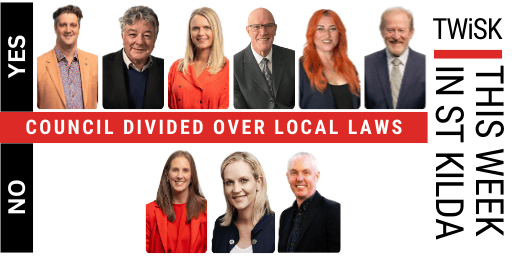
But the vote over proposed changes to local laws divided the council sharply, with Cr Halliday, Crawford and Buckingham voting against any change to the local laws. All other councillors voted to start the lengthy process to enact a local law for behaviour based triggers enabling encampments to be dismantled after ‘best efforts’ to find alternatives have been exhausted.
Before the vote, councillors heard a wide range of impassioned submissions from about thirty individuals representing residents, traders and community agencies. The submission were sharply divided on the merits of using local laws to respond to street level homelessness.
TWiSK was at the meeting and observed that the submissions were well organised and heartfelt. Councillors were left in no doubt that this is a topic that motivates and disturbs people from a variety of walks of life.
You can listen to the public testimonies here
TWiSK understands that there was significant effort behind the scenes to secure a unanimous position especially after so much collective investment in the Round Table, Housing Strategy and the revised Safety Plan.
Ultimately the ‘progressives’ insisted that the proposed new laws won’t work or are unnecessary. The organised ‘ratepayers’ rallied behind the idea that ‘doing nothing was not an option’.
This swung the spotlight onto independent councillors Makin, Cunsolo and Thomann who ultimately backed the new laws in a package with the unanimously supported strategies.
Effectively the six supporting councillors were saying, we’re funding a zero homeless program, we’re funding more community services, we’re funding a safety plan – we need a law of last resort.
Buckingham warns of legal risks
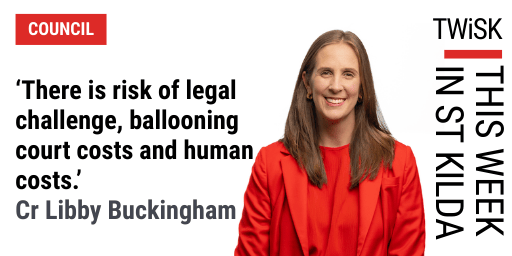
Cr Libby Buckingham, who headed the calls for a Community Safety Roundtable last December after the Synagogue arson, was steadfast in her opposition to adopting a new local law.
‘Everyone in [Port Phillip] has a right to safety and every councillor around this table is committed to making the city a safer place for everyone, the housed and the unhoused.
‘We’ve just passed a new community safety plan, a new housing and homelessness plan. We are actioning Ian Gray’s recommendations.
‘We have spent countless hours with Victoria Police, with the community service organisations, working on solutions that will make us all safer.
‘If there is an action that will improve community safety, I am putting my hand up for it. I’m the first person to jump on it and to pursue it.
‘My issue with changing our local laws is I do not believe it is going to make us safer. In fact, it could jeopardize our safety,’ she said.
Cr Buckingham pointed to the controversy when Moreton Bay Council in Queensland adopted similar laws in February this year. She said that the Queensland council faced millions of dollars of staffing and legal fees.
‘It’s been held up in the Supreme Court. And there are harrowing accounts of homeless people having their precious possessions thrown away.
‘This risk of legal challenge, ballooning costs, and human costs is too much for the city of Port Phillip. We have a very full dance card in implementing our community safety plan, implementing our homelessness plan. We need to stay focused on the actions that will make a difference,’ she concluded.
Neither utopia or dystopia says Mayor
Mayor Cr Makin said council was facing a wicked problem.
‘We’ve got a section of the community that think it’s going to be utopia if we do something, and a section of the community that thinks it’s going to be dystopia. The reality is it’s going to be neither. But we need a spectrum of tools that we can have on offer.
‘[These laws are about] Behaviours around an adverse amenity impact or a risk to safety or well-being. It’s a focus on behaviours that we need to remember here.
‘When we look at behaviours, there should be a common understanding of what is acceptable, and what is unacceptable. And that is why I believe there is merit in exploring [local laws that are] about behaviours, and we can then take a behavioural approach,’ he said.
TWiSK invited all councillors to submit a comment.