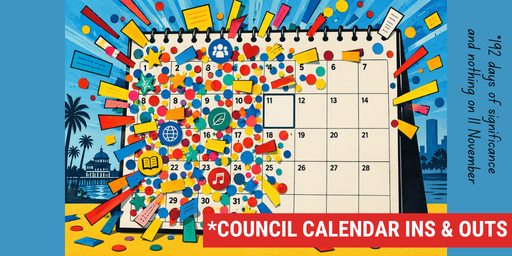

Last week, TWiSK reported that Council was poised to approve a calendar containing 192 significant days – but not Remembrance Day on 11 November.
The omission was particularly disappointing given Port Phillip’s close proximity to the Shrine of Remembrance and the extensive consultation, committee consideration and officer work behind the calendar.
TWiSK understands the correction was prompted by a councillor with a multicultural heritage that values Remembrance Day.
Council officers also added several other omissions – Passover, Yom Kippur and Krishna Janmashtami – while noting that the calendar is a living document requiring ongoing updates.
Yet, as several councillors pointed out, there is still no transparent public process for adding observances to – or removing them from – the calendar.
If this is genuinely a living document, Council should now publish clear criteria and a public process for future revisions.
“In Flanders Fields” by John McCrae
In Flanders fields the poppies blow
Between the crosses, row on row,
That mark our place; and in the sky
The larks, still bravely singing, fly
Scarce heard amid the guns below.
We are the Dead. Short days ago
We lived, felt dawn, saw sunset glow,
Loved and were loved, and now we lie
In Flanders fields.
Take up our quarrel with the foe:
To you from failing hands we throw
The torch; be yours to hold it high.
If ye break faith with us who die
We shall not sleep, though poppies grow
In Flanders fields.
Lieutenant Colonel John McCrae, a Canadian who served as a brigade surgeon for an Allied artillery unit, spotted a cluster of poppies that spring, shortly after the Second Battle of Ypres. McCrae tended to the wounded and got a firsthand look at the carnage of that clash, in which the Germans unleashed lethal chlorine gas for the first time in the war. Some 87,000 Allied soldiers were killed, wounded or went missing in the battle (as well as 37,000 on the German side); a friend of McCrae’s, Lieutenant Alexis Helmer, was among the dead.
Struck by the sight of bright red blooms on broken ground, McCrae wrote a poem, “In Flanders Field,” in which he channeled the voice of the fallen soldiers buried under those hardy poppies. Published in Punch magazine in late 1915, the poem would be used at countless memorial ceremonies and became one of the most famous works of art to emerge from the Great War. Its fame had spread far and wide by the time McCrae himself died, from pneumonia and meningitis, in January 1918.