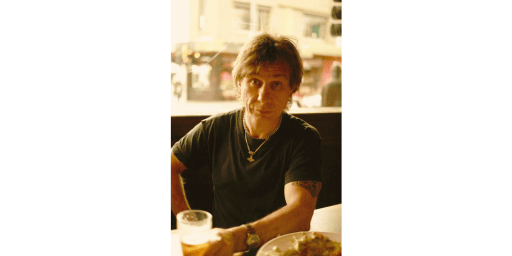

St Kilda has always been home ground for Interior Designer Danielle Brustman
If you live in a place for decades, its landscape is overlaid with a thousand different lives. I imagine a timelapse camera set up on the corner of Acland St, showing all the versions of myself that have lived in St Kilda: lumbering and pregnant, pushing a baby with a pram, cajoling a toddler, chasing a child and on it goes.
For artist and interior designer Danielle Brustman, St Kilda has always been home ground. Since moving here as a young adult in the late 90s, the suburb has changed around Brustman and she has lived many changing lives within it.
As a kid, she remembers visiting the expansive timber Tea Rooms on the St Kilda foreshore (where the Stokehouse now resides) with her dad, surrounded by elderly Jewish migrants. Later there were endless days and wild nights in a landscape that felt dangerous and thrilling. Brustman and her friends wandered Acland St, letting plans unfold serendipitously and drinking coffees at the Galleon surrounded by musos. And they spent hot summer nights at the Espy, sneaking through a secret door that led from the restaurant into the Gershwin room, to bypass the bouncers checking IDs so that they could see the bands play.
“St Kilda was very vibrant, eclectic, and colourful world. There was something very stimulating and magical about the streets,” she explains. Despite seeing the suburb shift with a wave of gentrification and the mass exodus of artists and old friends, Brustman still loves St Kilda. “I walk around with that sense of nostalgia even now.”
And Brustman finds a constancy to St Kilda, with its expansive seaside setting and art deco apartments. “There’s a sense of the old world, which you can’t take out of the equation,” she muses. “There’s something about that spatiality and architectural environment that I find very inspiring.” This stylistic influence can be seen in Brustman’s vibrant and impressive body of work which features circles and curves and rounded walls, echoing the Art Deco apartments that she has lived in.
Brustman hasn’t always wanted to be in St Kilda though. “There’s something wonderfully comforting about being here, but it can also be restrictive and claustrophobic, when your history is around you at all times.” In the wake of one of (many) breakup conversations that always seemed to happen at Claypots, Brustman found herself escaping. For stints, she moved across the river or further afield to Northern NSW or New York. But always, she returned.
In fact, when she lived in Fitzroy, she remembers, she’d find an excuse to drive to St Kilda to go to the supermarket. “For no other reason than that I missed it,” she laughs.
Now Brustman sees St Kilda through a new lens, as she is a mother to a ten-year-old. As she walks through the St Kilda Botanical Gardens or along Acland St, the spaces she once inhabited in young adulthood represent something else, a place where her daughter is growing up, and finding her own community.
And while Brustman has seen the shift in St Kilda, she is part of a lineage of women making art that continues. As a student, she remembers browsing an art supply store off Acland St, and often spotting Mirka Mora. “She was always very kind, she’d give me a big hug and I remember once she said to me: ‘Just keep going. Remember, just keep going with your art’”.
Danielle Brustman’s latest work, I Could Have Danced All Night, will be exhibited at the Jewish Museum in St Kilda from 13 August.
Feature photo of Danielle Brustman by Dylan James.

Storyteller: Alexandra Collier is an award winning Melbourne writer who has written for theatre, screen and print. Her memoir Inconceivable: Heartbreak, Bad Dates and Finding Solo Motherhood about her journey to becoming a solo mum by choice was published by Hachette in 2023. She is currently a writer on the new ABC/BBC detective series Return to Paradise.