
TWiSK wanted to know what our local MPs are hearing and thinking about community safety
So we asked ALL local state MP to respond to a simple survey
Community safety was a community concern in the last year’s council elections, the Prahran byelection, and the recent Federal election.
In just a couple of weeks, Ian Gray will present his report on the Community Safety Roundtable to Council. This will focus community discussion on what can be done to improve safety and rebuild community confidence with action by all levels of government.
To bring local members of State Parliament into the discussion, TWiSK has invited all local state members of parliament to respond to five questions about community safety. Their responses will be included in TWiSK as they are received.
To start the ball rolling, this week we present the response from David Southwick, State MLA for Caulfield and Shadow Minister for the topics of Police and Corrections, Youth and Future Leaders, and Youth Justice.
TWiSK has requested responses from James Newbury (Brighton), Rachel Westaway (Prahran) and Nina Taylor (Albert Park). Their responses will be published as they are received.
We asked for short responses and set no word limits. The answers are presented in full.
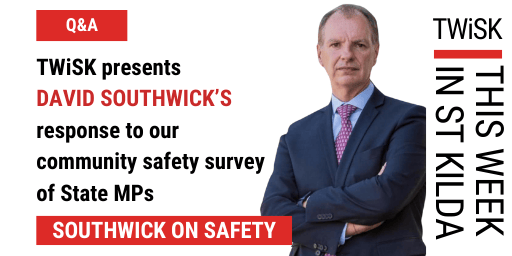
David Southwick’s response in full
Here is the response from David Southwick, State MP for Caulfield (which includes parts of St Kilda, Balaclava and Ripponlea).
Q1: How do you feel personally about community safety when you are going about your day-to-day activities with your family?
As a father and a lifelong member of the Caulfield and surrounds community, I share the same concerns as many Victorians when it comes to safety. Whether I’m walking down the street with my kids or meeting residents at a local event, there’s a growing sense that things just aren’t as safe as they used to be. Locally we are seeing an escalation of anti-social behaviour, particularly around our shopping precincts that in some cases are leading to violence.
We’re seeing more violent incidents in what should be peaceful suburbs, and it’s no longer a rare occurrence. Carjackings, home invasions, youth crime and antisemitism are on the rise. I believe every Victorian deserves to feel safe in their own neighbourhood—and right now, too many don’t.
I know many neighbours are paying for security patrols because they do not feel safe.
Q2: What are your constituents telling you about how they feel about community safety?
I speak with people across Caulfield and beyond every single day, and I can tell you the message is loud and clear: they’re concerned.
They’re concerned about break-ins, about walking home at night, about antisemitic attacks targeting our Jewish community, and about the fact that offenders often seem to get a slap on the wrist.
Different groups in the community have different concerns—older residents are particularly anxious about being targeted, while parents are concerned for their teenagers catching public transport or walking to school. The common theme is fear and frustration that not enough is being done by the State Government.
Q3: What do you think the community wants from the State Government on community safety? What could the State Government be doing differently to improve community safety?
The community wants a government that takes crime seriously and backs it up with action—not spin.
They want to see more police on the streets, tougher consequences for repeat offenders, and a justice system that puts victims first.
Right now, the Allan Labor Government is letting dangerous offenders back into the community, and the prison system is in crisis. We need stronger bail laws, more resources for crime prevention, and support for victims. A government I’m part of would focus on deterrence, accountability, and rebuilding community confidence.
Q4: What role do police play in community safety, and are they currently getting the resources they need to fulfill this role?
Our police do an outstanding job, but they are being stretched to their limits. I’ve been sounding the alarm on police shortages across Victoria—response times are blowing out, and officers are under enormous pressure.
Community safety starts with a visible police presence, but that’s not possible without proper staffing and resourcing. We need a clear plan to recruit and retain police, better support for officers dealing with frontline challenges, and investment in the tools and technology they need to do the job safely and effectively.
Q5: What is the role of other levels of government (both Federal and Local) in community safety? What more could they be doing now?
Community safety is a shared responsibility. While the State Government must lead on policing and justice, local governments play a big role in keeping neighbourhoods well-lit, clean, and safe through local infrastructure and youth engagement programs.
The Federal Government also has a role to play, particularly in counter-terrorism, cybercrime, and funding initiatives that address domestic violence and organised crime.
We need a coordinated approach—governments working together, not pointing fingers, and always putting the safety of Victorians first.