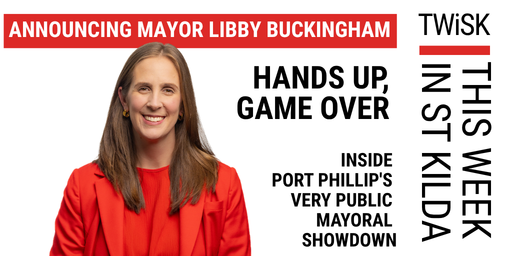
In a remarkable and highly unusual public vote, Labor Councillor Libby Buckingham has been elected as the new Mayor of the City of Port Phillip. The decision followed a bruising backroom process that ultimately saw the previous mayor, Councillor Alex Makin, transition into the role of Deputy Mayor.
Each year in November, the nine Port Phillip Councillors meet to elect a Mayor and Deputy for the next 12 months. The selection of mayor and deputy is normally conducted in private, with the ultimate result ratified formally in a unanimous uncontested election at a special council meeting.
Presumably this is designed to present a unified face to both the staff and the community, enabling the Mayor and Deputy to speak with authority.
But it will be no surprise to many that this has long been a proverbial fig leaf concealing a variety of issues, both personal and political
But this year’s mayoral and deputy mayoral ballot spilled over into a public vote. A boil-over with long-lasting implications for the effectiveness of the council.
Here’s what happened in public
After the nine councillors took their seats before the CEO at the special council meeting, nominations were called for the position of mayor. The CEO explained that the mayor would be the candidate who can command a majority of five votes. Keep that magical number five in mind.
After the CEO called for nominations, there was a pregnant pause, until Cr Libby Buckingham’s arm shot up. Her self-nomination was seconded by fellow Labor Cr Louise Crawford. Cr Bryan Mears was also nominated by Cr Serge Thomann and seconded by Cr Beti Jay.
Under the voting procedure, the first nomination is put to the vote to see if it can secure the magical five.
In that vote, four councillors joined Buckingham to secure her mayoral leadership for the coming year. The winning votes for Buckingham were cast by Councillors Crawford, Cunsolo, Halliday, Makin, and Buckingham herself.
Cr Mears’ nomination then lapsed.
Victorious Mayor Cr Libby Buckingham then replaced the CEO in the big chair and gave her inaugural speech. She outlined a vision focused on community connection, strategic continuity, and local resilience. Buckingham expressed deep gratitude to her council colleagues for placing their trust in her leadership.
Her first decision as Mayor was to call a short recess before the vote for the Deputy Mayor.
When council resumed a short time later, Cr Makin was elected unopposed as Deputy Mayor. It is highly unusual for a sitting Mayor to transition directly to the Deputy role in consecutive terms.
Following the vote and perfunctory light refreshments, Mayor Buckingham departed the venue driving the mayor’s official Toyota Yaris.
Behind the Scenes: What Just Happened?
While the transparency of a public vote is a refreshing change for Port Phillip, the intense behind-the-scenes machinations are likely to impact councillor relationships for the remainder of the term.
It is understood that three councillors took part in intense jockeying for support to secure the top job. To be clear, TWiSK regards this as a legitimate ambition. The role is a recognised opportunity to serve your community, promote unity and encourage community participation. It’s also very demanding, hard work that requires focus and commitment – and a tough hide.
But while the stakes are high, the odds are good out of a field of nine. Being mayor is considered a prestigious privilege that offers special access to the CEO, spokesperson duties, council meeting chairpersonship and profile at key events.
It is also generally treated as a full-time commitment, carrying an annual allowance of $146,640. By comparison, the deputy mayor’s allowance is $59,549 per year, while councillors receive $45,500.
‘On background’ from informed sources
Piecing together fragments of the full story from informed sources close to the process but unwilling to go on record, here is a general account of what just happened.
But first you need to remember that five is the magical number needed to win both the mayor and deputy mayor gig.
TWiSK understands that until recent events, Crs Mears and Thomann thought they had an arrangement to secure a Mears/Thomann team as mayor and deputy. In their minds the arrangement included a clear commitment of support from Cr Makin.
Meanwhile, Cr Buckingham was aware that she had four votes including her own – meaning she only needed one more vote to reach the magical five.
So far so good, but here’s where it gets murky and we’re not sure we’ll ever know the full story. Buckingham’s options for the fifth vote were Makin, Thomann or a long shot with Jay.
However, the options reduced dramatically when Thomann told Buckingham that his vote was already secured to back Mears for the top job with him as deputy.
At this point both Mears and Thomann were assured they had the support of Makin – giving them the magical five.
In proof that truth is stranger than fiction, Makin was simultaneously considering a second term – energized by the prospect of being a political independent during the transition to a possible new state government. Given Makin’s well-known passion for Fishermans Bend and public transport, you can appreciate that this was a seductive prospect.
But as the mayoral election grew closer, Makin’s grip on five votes evaporated. But not his dream of mayoral influence on his passion projects.
And the rest is now history. When Buckingham nominated, Makin’s hand went up.
And in the next vote, he became her deputy.
A Divided Council Faces Big Challenges
The political manoeuvring has created a finely tuned dynamic that is testing personal relationships across the chamber. As the new term begins, several critical questions hang over the town hall:
- How will Mayor Buckingham lead the chamber after such a bruising and divisive process?
- How will Cr Makin perform in his new role as Deputy to Buckingham?
- How will minority councillors participate after feeling locked out of the process?
Councillors lead the organisation, set direction and hold the CEO accountable. They can require information, challenge advice and pass motions directing change.
But an engaged majority is not enough to be an effective council, the minority voice must also be engaged.
Typically, each council agenda has hundreds of pages of paperwork (and often over 1000 pages) for councillors (and the public) to digest. While most of the nine councillors have other jobs that are their primary livelihood, this flood of information demands that councillors are unified and strategic in their scrutiny.
Ultimately, the core responsibility of the nine elected councillors is to oversee the work of the CEO and how the almost 900 staff members are directed.
Outnumbered one hundred to one by staff, a divided council makes effective oversight significantly more difficult.
Local voters elected all the councillors to oversee the delivery crucial local services and foster community unity—goals that will require the chamber to find common ground and work as a team.
TWiSK says, let social cohesion start with the councillors. And lets be transparent about it.