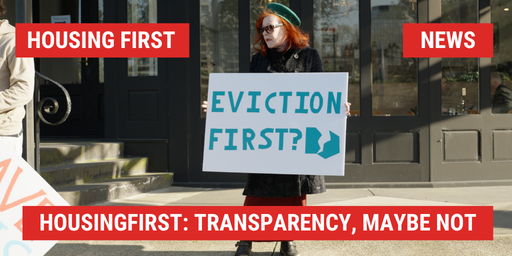
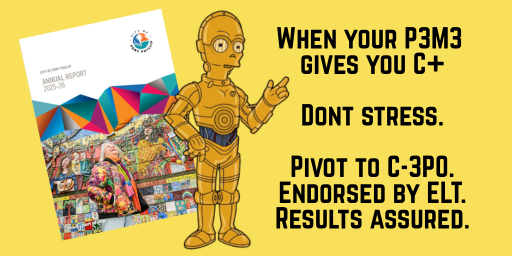
Disappointing results prompt a new operating model: a fix or just fresh language? Council’s answer sounds like something from Star Wars: introducing Council-3PO.
Buried in the dense, sanitised pages of Port Phillip’s latest Annual Report is a story of bureaucratic underperformance and damage control.
What began as a routine question about Council’s project management capabilities has revealed a mediocre self-assessment alongside a new governance model and supporting organisational changes.
At the heart of the matter is the Portfolio Delivery Improvement Plan. When TWiSK initially pressed the Council for concrete details regarding their project delivery performance, the response was a masterclass in corporate jargon—a dense fog of “tactical improvements,” “re-baselined” timelines, and “supporting organisational changes” – attached in full below.
A pointed follow-up finally produced a number. TWiSK asked where Council’s own P3M3 organisational maturity assessment—a measure of its project, program and portfolio management capability—placed it on the Level 1 to Level 5 scale.
The truth, as it turns out, was far from exemplary.
In a response attributed to Robyn Borley, General Manager of Governance and Performance, the Council carefully replied that its assessment placed it merely at the “higher end of Level 2” (defined as “Repeatable”).
Council’s explanation is straightforward: processes exist, but more work is needed to apply them consistently across the organisation. Its stated goal is the “mid-range of Level 3”, which it describes as “Consistent”. That is an ambition, not a result; the response gives no date for reaching it.
Against that modest Level 2 assessment, the structural shake-up deserves scrutiny.
Following an external governance review, the Executive Leadership Team endorsed a transition to a “Portfolio, Program and Project” (3PO) governance model. The Annual Report presents this as progress, and Council says the new operating model will strengthen program management. The test is whether the transition produces measurable improvement, not merely a new organisational chart.
And what will the “supporting organisational changes” mean for staffing and accountability?
Meanwhile, the work intended to improve delivery capability has itself stalled. The Annual Report notes that the Portfolio Delivery Improvement Plan was “placed on hold in quarter three”, citing “resourcing constraints” and the need to prioritise the Year 2 Council Plan and Budget. Key deliverables were “significantly delayed”, and the planned repeat organisational maturity assessment did not proceed in 2025/26. Council describes that assessment as on hold while the new governance model is implemented—not abandoned altogether.
Council says the delayed improvement actions “did not represent delays to specific capital projects or create changes to their budgets”. The maturity rating alone does not establish otherwise. But with Council acknowledging that its processes are not yet consistently applied, ratepayers are entitled to ask when the improvement work will resume and how progress will be measured. How much longer will “repeatable” be presented as good enough?
Too harsh? Always happy to carry a right of reply.
Annual Report 25-26
“Portfolio Delivery Improvement Plan
Progress was made in advancing the Portfolio Delivery Improvement Plan, focused on strengthening project portfolio governance, delivery capability and outcomes.
An external governance review was completed, with recommendations endorsed by the Executive Leadership Team and implementation commenced to transition towards a Portfolio, Program and Project (3PO) governance model.
Governance and assurance arrangements for high-risk, high-value projects were enhanced through strengthened controls and reporting. Improvements were also delivered in project communications, including updated signage, webpage guidelines and templates.
While resource constraints and budget development activities impacted the pace of some initiatives, these changes have established a stronger foundation for consistent and effective portfolio delivery across Council.”
AR 25-26 p 197
TWiSK Question
Following up on the 2025/26 Annual Report, Greg Day of TWiSK writes: The Portfolio Delivery Improvement Plan – designed to strengthen project governance and capability – was placed entirely on hold in quarter three due to resourcing constraints. Consequently, key deliverables were significantly delayed. Furthermore, a planned repeat assessment of high-risk, high-value projects was abandoned in 2025/26 due to these same resourcing challenges.
- Why was the Portfolio Delivery Improvement Plan paused, and when will it restart?
- What staffing or funding is required to complete the delayed deliverables?
- Which projects were affected, and what are their revised completion dates and budgets?
- Why was the repeat assessment of high-risk, high-value projects abandoned?
- How is Council assuring ratepayers that major projects remain properly governed without that assessment?
Media Response – to be attributed to City of Port Phillip General Manager Governance and Performance Robyn Borley
The Portfolio Delivery Improvement Plan is an organisation-wide capability improvement program.
The Improvement Plan was placed on hold in quarter three due to reprioritisation efforts to deeper review of portfolio governance arrangements while supporting delivery of the Council Plan and Budget Year 2.
A new portfolio governance model is now being implemented with some supporting organisational changes. These changes will enable sustained capability improvement and are deemed more important than the tactical initiatives in the Improvement Plan.
The repeat assessment of Council’s P3M3 organisation maturity assessment was placed on hold while this new model is being implemented.
Assurance of high-risk, high-value projects has been strengthened through:
- dedicated Project Control Groups
- use of independent stage gate assurance as deemed necessary
- monthly status reporting to the Executive Leadership Team
- reporting to the Audit and Risk Committee.
The delayed improvement actions did not represent delays to specific capital projects or create changes to their budgets.
The Portfolio Delivery Improvement Plan will be re-baselined once the governance and supporting organisational changes are completed in quarter 3. This will include tactical improvements to process, systems, training and quality assurance.
TWiSK follow up question
Greg Day of TWiSK asked a follow-up question to his previous questions relating to the Portfolio Delivery Improvement Plan: “Please specify the outcome of the original P3M3 organisation maturity assessment on the L1 – L5 scale. The statement implies that there was such an assessment, I’d like to know the level please.”
Media Response – to be attributed to City of Port Phillip General Manager Governance and Performance Robyn Borley
Council’s assessment placed us at the higher end of Level 2 – Repeatable – meaning we have established processes but there is further work to ensure they are consistently applied across the organisation.
We are working towards the mid-range of Level 3 – Consistent, with clearer and more consistently embedded processes and accountabilities.
Strengthening program management through the new operating model will be a key part of supporting this increase in maturity.