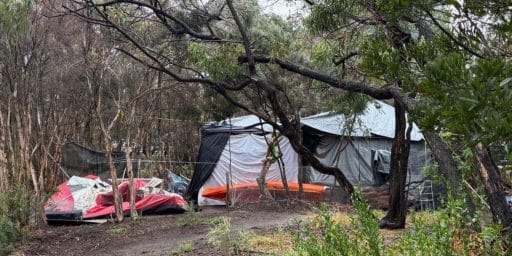
Yes, over a year. The current encampment prompted Parks Victoria to instruct vegetation rehabilitation volunteers to avoid the area on 16 April 2025.
Prior to that, a similar encampment occupied the area for three months before the 2025 Grand Prix, but left mysteriously – only to reappear weeks later as the current camp.


Repeated response remains the same
The site is on Parks Victoria land and responsibility clearly lies with them rather than council. We again asked Parks Victoria for a response and received the same reply we have received three times before:
“As the land manager of Albert Park, Parks Victoria is working closely with a range of agencies, including specialist support organisations. This work is focused on a sustainable outcome that addresses health, safety, environment, and welfare considerations. Every Victorian deserves access to a safe and secure home, and that’s why we’re working closely with specialist agencies to support people who are experiencing or at risk of homelessness.”
On background, Parks Victoria also reminded us of the State’s commitment to homelessness services:
“We invest more than $300 million into specialist homelessness services every year, benefiting over 100,000 Victorians who are at risk of or experiencing homelessness. Victoria has the highest total recurrent expenditure on homelessness services across all jurisdictions. The Victorian Budget 2025–26 delivers $61 million to continue services including assertive outreach and housing support for people sleeping rough and Aboriginal‑specific homelessness entry points.”
Local MP Nina Taylor organised the response from Parks Victoria and added the following information about community safety:
“If urgent police assistance is required, the community should call 000. For non‑urgent assistance, the Police Assistance Line (131 444), online reporting, and Crime Stoppers (1800 333 000) are available.”
Out of sight, out of mind ain’t good enough
The encampment is meeting a basic need – shelter and community. The fact that it has lasted for over a year should raise serious questions about government and agency responses rather than disdain for the campers.
Sleeping in a park, in all weather and all seasons, without basic services or amenities, is not a ‘walk in the park’.
We can only commend the agencies that continue to reach out with compassion and concern. We must look to them – and to camp residents – for new ideas on how to respond to people camping out.
We must never forget that there are people in those tents, probably fewer than 20 individuals. People who, for one reason or another, are struggling to survive on the fringe.
Clearly, we need more than additional funding for assertive outreach. We need assertive cooperation between specialist agencies, council, police and the community.
That’s not going to happen if we pretend it’s not happening.