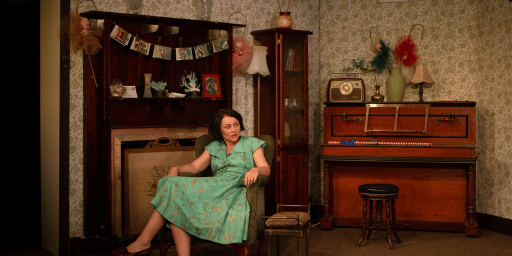
It’s 1945 and eight tawdry kewpie dolls, marking each year since the sacred summer ritual took root, decorate the otherwise unchanged boarding house. Though the boots hanging from the light shade suggest the contrary, gone is the exuberant youth of Kid Stakes. These are Other Times, indeed.
The second instalment of Ray Lawler’s monumental The Doll Trilogy, given new life by Red Stitch as the ambitious centrepiece of its 2026 season, Other Times functions more as a bridge than a destination. The play, described by actor Ben Prendergast as “the fulcrum of the trilogy”, inhabits an eerie in-between. Unlike its predecessor and the youth it represents, Other Times is propelled not by anticipation but by loss, not by action but by absence. The tension doesn’t buzz with what could be, but hangs with what could have been. These aren’t kid stakes; these are adult ones.
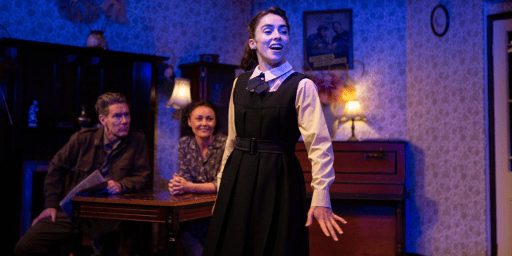
It’s the end of WWII and Roo and Barney (Prendergast and John Leary), enlisted men for five years, return to the boarding house prepared to sink back into ritual without rupture. While Olive’s (Ngaire Dawn Fair) wide-eyed idealism remains stubbornly unchanged, the same cannot be said for Nancy (Emily Goddard), whose disillusioned days are now numbed by the comforting haze of whiskey. Next-door neighbour and surrogate little sister Bubba (Lucinda Smith) is now 14, an echo of a bygone girlhood, and Emma (Caroline Lee), keen to live out her remaining days in comparative luxury, considers giving up the boarding house to salvage something for herself. A quiet fracture occurs with the arrival of German-Jewish refugee Josef (Khisraw Jones-Shukoor) and his ensuing connection with Nancy, exposing prejudices uncomfortable to face.
While the ensemble is remarkably cohesive, showcasing the growth of their characters and the impact of the war on their psyches with nuance and care, Other Times is truly Goddard’s show. The confident, unencumbered Nancy of Kid Stakes, strutting around the boarding house with a striking self-assuredness, is but a shadow of her former self: a woman worn down by both the life she chose and the life she didn’t. Goddard’s powerful embodiment of this duality, this deeply human trajectory, is the anchor of the show: a tragedy all the more tragic in its mundanity.
Other Times doesn’t raise a glass towards “happy days” and “glamorous nights” as Kid Stakes did. The future doesn’t sparkle with possibility, doesn’t promise opportunity. Other Times sits in the stillness, lingers on the past, and testifies to the disenchantment that often lies on the other side of adulthood.
Image by Chris Parker: Ben Prendergast, Ngaire Dawn Fair, Lucinda Smith