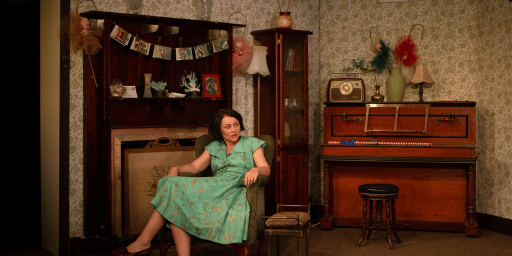
At the onset of Summer of the Seventeenth Doll, the room we’ve come to know is overgrown with memorabilia from summers past. Kewpie dolls—sixteen of them—are fastened to the wall like art, poking from vases and hanging from light fixtures, shrouding the space in tinsel and tulle. Butterflies—dried and framed—hang above the piano. Photos are strung across the mantle, reminders of the love and laughter of their youth. By the end, the room is bare, the decorations taken down, the colour drained. This summer is to be the last.
Few plays loom as large in the Australian theatrical imagination as Summer of the Seventeenth Doll, the tragic final chapter in Ray Lawler’s The Doll Trilogy and the culmination of Red Stitch Actors’ Theatre’s momentous revival of the three-play saga. It’s 1953 and something has shifted. Nancy is gone, married and moved on, and her presence looms like a ghost, haunting the space she once called home. In her absence lies a reckoning that will reduce the rituals of the past two-decades to rubble.
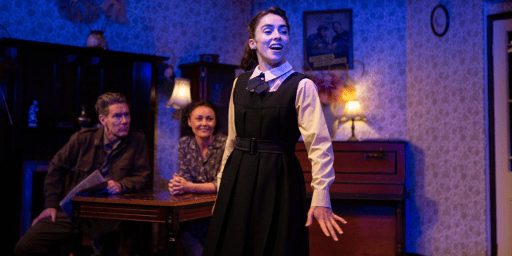
Though Emily Goddard’s transformation from Nancy in Kid Stakes and Other Times to the “hoity-toity” Pearl—mouth downturned and lips perpetually pursed—showcases remarkable range, if Other Times was Goddard’s show, The Doll is undoubtedly Ngaire Dawn Fair’s. As tragic heroine Olive, Fair charts a devastating decline from youthful optimist to woman on the brink of collapse, refusing to confront the harsh reality her “five months of heaven” conceal. As Roo and Barney, men whose mateship and masculinity are put to the test, Ben Prendergast and John Leary give their strongest performances yet, while the ensemble at large remains a formidable force. Ella Caldwell’s direction, too, ensures the drawing-room dramas never grow stale across the trilogy’s eight-hour runtime, deftly balancing movement and momentum with stillness and silence, allowing moments to breathe—or suffocate—when needed.
While the three-play structure naturally invites a game of spot-the-difference, tracing in the space and stagecraft what has changed over the intervening years, what’s perhaps more intriguing is how the same choices assume new meaning as the trilogy unfurls. Rachel Burke’s necessarily naturalistic yet subtly evocative lighting design conveys this almost undetectable transformation beautifully: the cool blue light of night that shone with mystery and intrigue in Kid Stakes now casts a despondent veil over the room in The Doll. The golden hue of promise that filters through the windows now evokes a faded photograph. The lamps illuminate between scenes as they always have, but though nothing has changed, somehow everything has.
The same sentiment extends to Daniel Nixon’s sound design, which—less bound to the diegetic world—evolves quietly yet markedly as the plays progress. While music is used seldomly, guiding transitions rather than accompanying scenes, it too traces the emotional landscape of each piece. The unexpected rhythmic drumming of Kid Stakes—full of energy, hurtling towards an exciting, unknowable future—gives way to smooth, soft jazz in Other Times, which in turn yields to The Doll’s haunting lullaby. But it does so discreetly, imperceptibly; like the passing of time, you only notice if you pay close attention. And in this case, the venue invites you to.
As usual, the incredibly intimate Red Stitch Actors’ Theatre uses its scale to its advantage, embedding us in the cramped living space and, in turn, in the sprawling lives of Lawler’s strikingly authentic characters. With beautifully crafted, thoughtfully designed pieces that enrich the story without distracting from it, set and costume designers Jacob Battista and Sophie Woodward create a world all the more immersive in its unobtrusiveness. A functioning staircase leads to an upstairs obscured from view, while the audience entrance and opposing wing become in-world spaces in their own right. Voices shout from offstage, spilling into the space and blurring its boundaries, as actors sit on the stairs that lead to the theatre’s seating, spatially infiltrating the audience. It is as if the world beyond the room—barely touched by the passage of time—is a mere suggestion: a choice that amplifies the mundane tragedy at the heart of The Doll.
Though there’s no question that Summer of the Seventeenth Doll stands on its own (it did for twenty years, after all), it’s not an overstatement to say that only when viewed alongside the play’s prequels does the breadth and depth of Lawler’s profound, multi-layered character study truly emerge. Seen together, the grand finale is not just a poignant portrait of illusion and arrested development, but a tragedy tracing the transformation of vitality into mythology, tradition into prison, hope into despair.