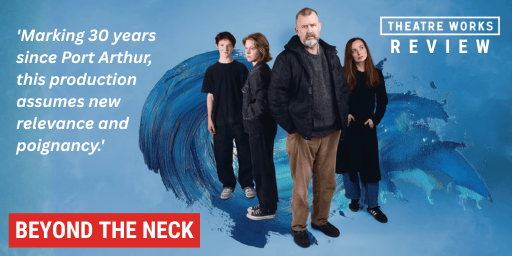
Theatre Works new staging of Tom Holloway’s Beyond the Neck, an emotionally resonant work based on testimony from those affected by the Port Arthur massacre. Marking 30 years since thirty-five lives were lost, this production assumes new relevance and poignancy in the wake of the tragic Bondi shootings. Review by Olivia Di Grazia.
The stage is almost uncomfortably bare. Four brown wooden chairs, lined up like a string quartet, sit on a sandstone-coloured floor, swallowed by blackness. An enlarged oil painting—at once picturesque and disquieting—hangs, suspended in the abyss. The painting is Tasmanian artist Rodney Pople’s controversial modern landscape Port Arthur, depicting the scenic convict ruins of a colonised Australia. In the foreground, almost hidden within the shadowy yet idyllic scenery, is the small, ghostly figure of Martin Bryant, weapon in hand. As the stories of those affected take centre stage—unfurling, overlapping, intensifying—the painting lingers, haunting the space as Port Arthur haunts our cultural memory. Grief hangs, too—invisible yet impossible to ignore.
It is this tension between the abstractness of history and the immediacy of human experience that Theatre Works illuminates in its new staging of Tom Holloway’s chamber piece Beyond the Neck, a powerful and emotionally resonant work based on real accounts from those affected by the Port Arthur massacre. Marking 30 years since thirty-five lives were lost and twenty more wounded in an act of senseless violence that shook the nation, this production assumes new relevance and poignancy in the wake of the tragic Bondi shootings on the 14th of December 2025. Set ten years after that harrowing day in 1996, Beyond the Neck follows four individuals—an old man, a young wife and mother, a teenage girl, and a young boy—whose disparate stories intersect at the site. With storytelling poetic yet grounded, emotional and embodied, their interwoven monologues form a complex tapestry of grief, loneliness, and resilience in the wake of tragedy.
The simplicity of Emma Ashton’s set design—evoking an island to mirror the isolation of Tasmania, Port Arthur, and the characters—ensures there are no distractions from the deeply human stories to which we bear witness. With only four chairs to transport us between stories, across locations, and through time, director Suzanne Chaundy brings a purposeful propulsion to the piece, oscillating between exacting movement and striking tableaus that recall the haunting stillness of the painting hanging above. Chaundy’s command of the text is masterful—teasing out its music like the most seasoned conductor and revealing an authenticity in its characters that refuses sentimentality. It’s hard to imagine an interpretation of Beyond the Neck that could rival the simple ingenuity of this one.
The play—subtitled A Quartet on Loss and Violence—is propelled by the performances of its ensemble, all of whom carry the sensitive material with the precision and cohesion of a symphony. Francis Greenslade is the anchor as the Old Man, a tour guide relying on repetition and the mundanity of his everyday life to avoid confronting the reality of what he witnessed on that fateful day. As the calm counterpoint to the other characters, as the constant, when the Old Man is triggered, the contrast is palpable—a stark reminder of the trauma that persists long after atrocity. Emmaline Carroll Southwell’s Young Wife and Mother, on a bus tour planned and paid for by her workplace, is emotionally arresting: a woman whose grief lies dormant in denial until it can no longer be ignored.
As the Teenage Girl who lost her father in the massacre, Cassidy Dunn captures an adolescent anger shaped by immense loss, shrouding herself in a big brown hoodie as if to shield herself from a world she cannot trust. Though it’s the chemistry and cohesion of the four actors on which the play rests, Freddy Collyer’s cricket-obsessed Young Boy is the stand-out performance. Collyer embodies the seven-year-old’s frenetic energy and all his youthful quirks—tugging at his sleeves, scratching his head, contorting his limbs—while never veering into caricature. His ability to balance the character’s boyish innocence with a latent darkness shows remarkable range, and makes the viewing experience all the more impactful for it. The performances are aided by Philip McLeod’s haunting string compositions, which divide scenes and guide the play’s tensest moments, providing an arresting backdrop on which the words—music in their own right—can sing.
Not only does the ensemble portray their own characters, but they also, as noted by Chaundy, “become a chorus who help each character tell their story by prompting, elaborating and even sometimes disagreeing about how it should be told.” This layering of the personal and the collective is quietly profound. It raises questions about whose stories are told, how those stories are told, and whether they can ever be truly pinned down. But the play’s power lies precisely in its ability to capture traumatic experience and the non-narrative memory it produces, rendering it in form as well as content.
Events are not recalled coherently, but instead break into consciousness in fragments over time. Memories, like the chorus, intrude—collapsing past and present, and endowing the piece with a fractured, fragile quality. In Beyond the Neck, Holloway ensures trauma and PTSD are not just represented, but enacted. The relentless intensity—even if, at times, it makes the interweaving plots difficult to trace—manages to speak an experience often deemed “unspeakable” with astounding compassion and depth.
Though you may get tangled in the tapestry from time to time, Beyond the Neck succeeds resoundingly in what seems to me its central mission: to make you feel that which is (almost) inexpressible.