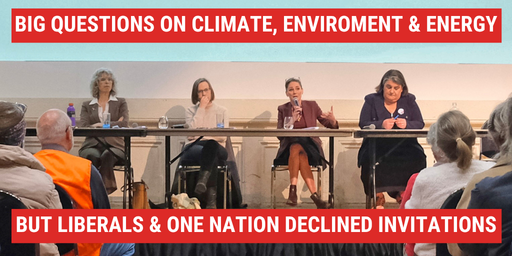
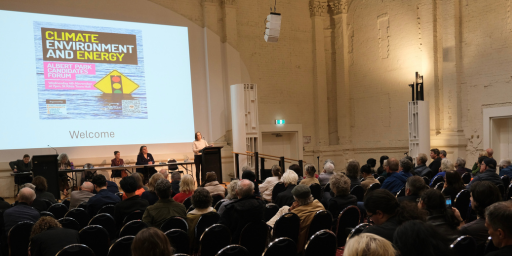
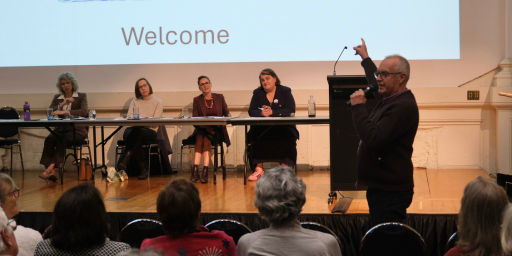
PECAN (Port Phillip Emergency Climate Action Network) hosted a climate, environment and energy candidates’ forum on Wednesday night at the St Kilda Town Hall. TWiSK went along to hear the policies, watch the candidates perform and see what questions emerged.
What happens when you call for a debate and one side does not show up? Although all candidates for Albert Park were invited, four candidates did not take up the invitation – namely Animal Justice, Liberal, One Nation and Independent Adrian King*. The organisers tried to ‘balance the books’ by offering summaries of what the missing candidates might have said based on their websites.
Despite the missing candidates, the progressive candidates in the room delivered their opening pitches in earnest.
Greens Sonya Semmens offered her clarity and passion, while Labor’s Nina Taylor brought a fired-up enthusiasm to proceedings. Socialist Colleen Bolger and Independent Georgie Dragwidge were both genuine and concerned, but the detail of the climate and energy debate was not their strong suit.
Four get five minutes each
The PECAN organisers gave each candidate five minutes to set out their credentials and policies. Speaking order followed the order in which candidates had responded to the invitation, rather than a random draw. Cute.
Sonya Semmens (Australian Greens):
Climate and environment are her special subjects
Sonya Semmens opened by framing climate change as an active, life-threatening emergency rather than a future threat, recalling the personal impact of the 2020 bushfire smoke on her family. She criticised the Labor government for approving five new fossil fuel projects and drilling near the 12 Apostles. Semmens emphasised that the Greens refuse donations from the fossil fuel lobby, allowing them to advocate for replacing coal and gas with cheaper, publicly owned renewable energy. Her platform also includes permanently ending native forest logging and banning ocean gas drilling.
Nina Taylor (Australian Labor Party):
We’re doing it, and we’re getting it done
Nina Taylor positioned Labor as the party of practical action, contrasting their record with the fossil-fuel-obsessed Coalition and One Nation’s nuclear proposals. She highlighted Labor’s success in surpassing its 2025 renewable energy target and committing to 95% renewable energy by 2035. Taylor detailed key achievements, including the construction of dozens of wind and solar farms, the rollout of 25 big batteries, and the revival of the State Electricity Commission. She also noted policies promoting all-electric new builds, public transport solar offsets, and local environmental investments.
Georgie Dragwidge (Independent):
Shares community concerns
Independent candidate Georgie Dragwidge, owner of Georgie’s Harvest, shared how droughts, bushfires, and floods directly impact local farmers and drive up the cost of living. She argued that environmental considerations must be integrated into every government decision, from housing to transport, rather than treated as an isolated issue. Dragwidge advocated for science- and evidence-based policy over party politics. If elected, she promised to act as an independent community voice, holding the government accountable to its targets, improving local bike paths, and protecting Albert Park Lake.
Colleen Bolger (Victorian Socialists):
Catastrophic problems deserve radical solutions
Colleen Bolger argued that the scale of the climate crisis demands radical solutions that directly challenge corporate profits. She criticised the Victorian government’s emissions targets as inadequate compared to the Paris Agreement, noting that official figures exclude exported fossil fuel emissions. Bolger proposed renationalising energy companies to fund renewable investments, taking public transport back into public hands, and implementing strict energy-efficiency standards on new builds. She concluded that capitalism is the root of the environmental crisis and urged voters to support socialist alternatives.
A rambling Q&A covers plenty of ground
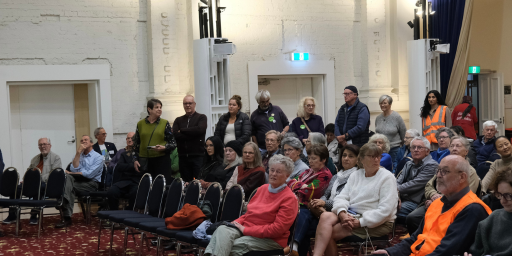
About a dozen people formed two long queues, with impassioned statements often preceding a baker’s dozen of questions. What follows is TWiSK’s edited collation of the candidates’ responses to six selected questions, rather than a verbatim transcript or a complete account of the Q&A.
How can we ensure the broader community is better educated in the science of climate change?
Georgie Dragwidge (Independent): Advocated for changing how we communicate by using learned scientists to present facts directly, simplifying the message, utilising social media, and having inclusive, non-political conversations.
Nina Taylor (Labor): Highlighted Labor’s funding of grassroots organisations like the local EcoCentre ($3.35 million) to educate schoolchildren and run citizen science programs, alongside the State Electricity Commission (SEC) providing transition advice.
Colleen Bolger (Socialists): Argued that the issue is not a lack of education, pointing to youth-led climate strikes, but rather a failure of major parties to listen to and empower the community.
Sonya Semmens (Greens): Suggested using powerful personal storytelling alongside the clear language of economics to demonstrate the urgent financial incentives of moving to renewables.
What support can you offer to people who cannot afford the upfront costs of home electrification retrofits?
Sonya Semmens (Greens): Promoted the Greens’ Power Voucher scheme, offering $1,500 for owner-occupiers and $3,000 for renters to install solar, batteries, insulation, and efficient heating, alongside plug-on solar policies for apartments.
Nina Taylor (Labor): Pointed to the existing Victorian Energy Upgrades scheme and newly legislated minimum energy-efficiency standards for rental properties (phased in from 2027) covering insulation, draught-proofing, and hot water upgrades.
Colleen Bolger (Socialists): Supported the voucher and rental standards but argued they do not go far enough; developers should be mandated to meet premium energy-efficiency standards on all new builds.
Georgie Dragwidge (Independent): Committed to ensuring that government programs are delivered in a cost-effective way for the local community.
What should be done about the fast-tracked Fishermans Bend AI data centre and its associated safety/environmental risks?
Sonya Semmens (Greens): Expressed deep concern over the fire risks near the West Gate Bridge, grid strain, and lack of consultation. She called for a strict moratorium on all hyperscale data centres until a national regulatory framework forces them to fund their own renewable power and water.
Colleen Bolger (Socialists): Highlighted the massive global emissions of AI data centres and criticised the state government for approving the project just 75 days after submission without adequate public scrutiny.
Nina Taylor (Labor): Defended the need for data sovereignty but emphasised that strict guardrails must be enforced, requiring projects to use renewable energy, recycle water, and meet rigorous Fire Rescue Victoria and EPA safety standards.
Georgie Dragwidge (Independent): Criticised the lack of community respect and consultation, stating that boundaries and parameters for the project were completely inadequate.
Will you commit to allocating 5% of Victoria’s annual transport budget to protected cycling infrastructure?
Georgie Dragwidge (Independent): Enthusiastically supported the cycling campaign, noting that protected bike paths make logical sense and should be built out of Fishermans Bend with proper community consultation.
Sonya Semmens (Greens): Confirmed the Greens’ strong support for the “Give Me 5” campaign to fix dangerous gaps in the network, alongside broader investments in active and public transport.
Colleen Bolger (Socialists): Supported the pledge, suggesting the funding could be secured by renationalising the public transport system and redirecting the massive profits currently paid to private operators.
Nina Taylor (Labor): Committed to advocating for the policy, pointing to Labor’s successful delivery of the transformative St Kilda Road bike lanes and the integration of safe, segregated pathways into major state projects.
What is your position on the phase-out or expansion of fossil fuels?
Nina Taylor (Labor): Stated that gas reserves in Victoria are naturally declining and emphasised that the government’s focus is on transitioning households off gas to expedite the shift to clean energy.
Colleen Bolger (Socialists): Opposed catering to corporate interests, arguing that instead of letting companies drill the remaining gas, the state must shut down these industries and reclaim corporate super-profits.
Sonya Semmens (Greens): Stated a clear, absolute position: “No new coal and gas,” advocating for an immediate, urgent transition to renewables with a just transition plan for fossil fuel workers.
Georgie Dragwidge (Independent): Advocated for running toward renewables to ensure affordable, reliable energy while making realistic, scientifically backed choices.
How will you protect low-lying local suburbs from rising sea levels and flooding?
Sonya Semmens (Greens): Noted that a third of Port Phillip faces severe flood risks. She proposed a “polluter pays” model—drawing on Scandinavian and Canadian practices—to fund the massive infrastructure investments required for flood mitigation.
Nina Taylor (Labor): Highlighted that the government is actively working on adaptation plans, releasing critical data, and implementing planning changes (such as elevated parking in high-density builds) to prepare for future flooding.
Colleen Bolger (Socialists): Argued that lowering emissions is the primary defence to prevent the worst impacts, but also called for massive public investment in emergency services, rescue operations, and resilient infrastructure.
Georgie Dragwidge (Independent): Promised to act as a direct lobbyist for the community, constantly pressuring the government of the day to implement flood protections so local homes do not end up underwater.
Across the answers, agreement on the need for action did not mean agreement on the means. Taylor emphasised Labor’s record and existing programs; Semmens pressed for faster change and no new coal or gas; Bolger argued for public ownership and a challenge to corporate profits; Dragwidge stressed evidence, consultation and local accountability.
But one big question remains
If climate and environment are issues of our generation, why was the Town Hall only one third full?
* Independent candidate Adrian King was unable to attend the whole event. He attended part of the event but did not speak.