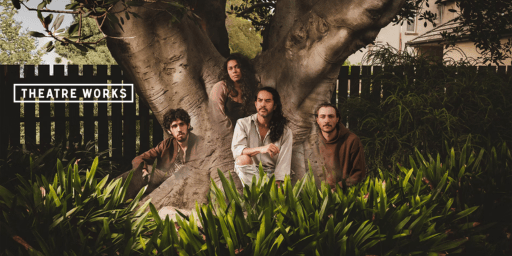
Tix and session info: playing at Theatre Works until 6 June
Opening night of Theatre Works’ Lazarus began not in the theatre, but in the courtyard just outside it. It began with a group of people, quiet and reverent, gathered around the very subject of the play we were about to witness: Taungurung Elder Uncle Larry Walsh. It began with Theatre Works’ First Peoples Advisor, Uncle Glenn Loughrey, sharing a Welcome to Country, acknowledging the Boonwurrung land on which we gathered, and explaining why he was not, in fact, going to perform a smoking ceremony. “I don’t want you to be protected from Uncle Larry’s story,” he said. “I don’t want you going into this theatre thinking, ‘Oh, now I’m safe; I’ve done a smoking, I’ve cleansed myself and I’m protected.’ I want you to take your story in, get it to connect with his story, and to be disturbed by that story, so that we change.”
With this invitation in mind, the full house filtered into the theatre not as individuals but as a collective, aware we were sharing in traditions embedded in the land since – as Uncle Glenn reminded us – before time itself: story and ceremony. Written by John Harding, a founder of ILBIJERRI Theatre Company, Lazarus chronicles the true story of Taungurung Elder, activist and storyteller Larry “Lazarus” Walsh, tracing with humour and poignancy the trials and transformation of the extraordinary man seated in the front row. Kamarra Bell-Wykes’ visionary direction sees not one but three actors embody Walsh from Boy to Man to Elder, folding his metamorphosis into the form of the work itself and foregrounding the transgenerational impact of colonisation on First Nations peoples.
Courtesy of set-designer Justin Green, a semi-circle of native plants delineates a stage on the floor. A patchwork of warm, earth-toned cloths – fraying at the edges – hangs upstage: a blank canvas dirtied with history. Projected across this backdrop are videographer Cobie Orger’s moving images, beginning with a powerful montage in which the faces of the three performers portraying Larry (Nathan Wright, Riley Warner, and Sermsah Bin Saad) morph into each other as they circle one another onstage – a recurring ritual that punctuates the piece.
Divided into thirds, the actor portraying Larry at each stage of his life narrates directly to the audience, while the ensemble – comprised entirely of First Nations performers – shifts seamlessly between the many characters who orbit him. Nathan Wright carries the first stretch of Larry’s story, bringing both vulnerability and a cheeky, mischievous edge to a childhood and adolescence shaped by removal, institutionalisation, and state control. While Bell-Wykes’ kinetic direction never shies away from the injustice underpinning the story, she leans into what she describes as a “slapstick form,” honouring the Blak humour she identifies “at the heart of [her] community’s survival and resistance.” Embodying this Blak humour is the fabulous Teresa Moore who, portraying every female character in the show, injects Lazarus with much needed levity and physical comedy. The show shifts registers as Riley Warner takes the reins, commanding the stage with a mesmerising larrikin spirit that steals every scene he’s in.
However, as Sermsah Bin Saad takes over the show’s final third, the production’s propulsive momentum begins to falter. While his expressive indigenous dance adds another dimension to an already dynamic work, noticeable lapses in line memorisation on opening night ultimately flattened the impact of what should have been a powerful and moving progression from man to Elder. Disrupting both rhythm and narrative, the final part of Larry’s story – the emergence of the activist and storyteller we know today – was unfortunately lost, and with it the weight of the show’s final moments.
Nonetheless, Bell-Wykes’ vision is a testament to the power of theatre as a vehicle for truth-telling and art as a form of memory activism. Humorous and heart-wrenching, heightened yet human, Lazarus presents Larry’s story as he does himself: not as tragedy but as testimony. Before the show, Larry testified to this. “When we did the readings, it sounded a little bit too much like things went wrong,” he said. Shrugging, he continued, “But I learnt through everything that went wrong.” That, ultimately, is Lazarus.