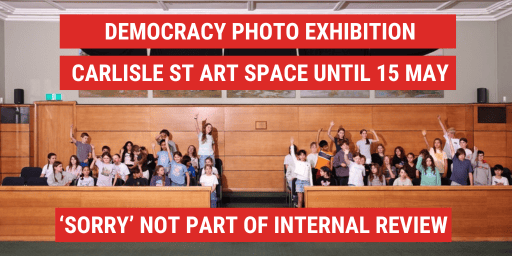
Picturing Democracy is a 13‑week exhibition at council’s own exhibition venue, the Carlisle Street Arts Space, in the St Kilda Town Hall, scheduled to run until 15 May.
In promoting the exhibition, council said:
“Picturing Democracy imagines what democracy might look like through the representation of community, participation and people of the City of Port Phillip.
Drawing from 4,000 photographs held within the Port Phillip City Collection, and in addition to creating his own photographs, artist and curator Ross Coulter poetically and playfully re‑imagines what democracy looks like, from the past and into the future.”
However, from opening night, questions were raised about the absence of key democratic milestones from the exhibition. It quickly became apparent that most significant moments in local democratic history had been overlooked.
There were no references to the Turn the Tide campaign, protests over council amalgamations, the Grand Prix, the St Kilda Triangle, the same‑sex marriage campaign, community childcare, or a range of other significant civic moments.
It may be that the exhibition did not align with everyone’s definition of democracy – not unusual in a democracy.
But matters took a more serious turn when Elwood resident Isaac Herman addressed council in March.
Many questions to answer
Mr Herman asked 15 questions relating to what he described as the exclusion of minority communities from the exhibition.
Referencing exhibition text asking “who and what is not seen”, he questioned whether the absence of minority communities was acceptable, and how such exclusions could be reconciled with claims of social inclusion.
He specifically highlighted the absence of Jewish, Buddhist, Chinese, Taoist, Confucianist, Hare Krishna and Hindu places of worship, asking how these omissions enhanced inclusion in a city with long‑established multicultural and multifaith communities.
Despite what he described as significant Jewish and Chinese material being available in the City of Port Phillip Collection, Mr Herman said Jewish content accounted for just one of 106 images, while Chinese content was entirely absent.
The questions prompted an internal council review. That review has now been completed but has not been released publicly.
TWiSK sought the full review and received instead a summary of responses to Mr Herman’s questions, along with a statement from council chief executive Chris Carroll.
Mr Carroll said the review found the exhibition had been developed in line with its approved brief and identified no non‑compliance, discriminatory intent, or political or ideological direction.
“The exhibition was delivered under an artist‑led curatorial model and was not intended to be a comprehensive or representative survey of all communities, faiths or geographic areas,” he said.
‘Nothing to see here’
For Mr Herman, that response only reinforced his concerns.
Speaking to TWiSK after receiving the council correspondence, he said the process left him feeling invisible.
“Rather than being an opportunity for social inclusion, this made me feel invisible,” he said.
“When you make people invisible, it’s much easier to treat them badly.”
Mr Herman said the review process added insult to injury.
“The review has run its course internally and failed. There needs to be – and must be – accountability.”
Mr Herman told TWiSK that he’d expressed dissatisfaction with the review, and “to Council’s credit”, a review of the review has now been initiated.
And that’s not surprising given how this council has taken a national leadership role of social inclusion especially since the Bondi shootings.
But also because there is an underlying disconnect between the exhibition and our community.
Council has a proud connection to the local Jewish and other faith communities, including many mayors, councillors, officers and residents who are active in their faiths.
Yet somehow, an exhibition on our very rich and vibrant democracy in Port Phillip could be so naïve as to be offensive.
Why is ‘sorry’ the hardest word?
The exhibition has become an embarrassment on multiple levels. The obtuse internal review has compounded that embarrassment.
The refusal to offer any hint of apology is breath taking and itself evidence of a disconnect from democracy itself.
This is the closest council has come to an acknowledgement of fault, according to the CEO’s statement:
“While the review confirmed the exhibition met its requirements, it identified opportunities to strengthen council’s cultural programming processes, including clearer definition of scope at commissioning, enhanced risk assessment for exhibitions that may raise community sensitivities, clearer guidance around source materials, and more transparent communication about curatorial independence and council’s inclusion commitments.
In response to feedback, council amended exhibition text to encourage broader community engagement and committed to embedding the review’s learnings to strengthen future cultural programming. Council reaffirmed its commitment to balancing artistic independence with improved governance, transparency and community understanding.”
Everything except one simple five‑letter word.
The exhibitor was contacted for comment be declined because he had not seen the review.
Statement from CEO (in full)
“Council responded to correspondence regarding the Picturing Democracy exhibition by outlining the findings of its review into the exhibition’s development, governance and alignment with the Exhibition Commission Brief.
The review found the exhibition was developed in line with its approved brief and identified no non‑compliance, discriminatory intent, or political or ideological direction.
The exhibition was delivered under an artist‑led curatorial model and was not intended to be a comprehensive or representative survey of all communities, faiths or geographic areas.
While the review confirmed the exhibition met its requirements, it identified opportunities to strengthen council’s cultural programming processes, including clearer definition of scope at commissioning, enhanced risk assessment for exhibitions that may raise community sensitivities, clearer guidance around source materials, and more transparent communication about curatorial independence and council’s inclusion commitments.
In response to feedback, council amended exhibition text to encourage broader community engagement and committed to embedding the review’s learnings to strengthen future cultural programming. Council reaffirmed its commitment to balancing artistic independence with improved governance, transparency and community understanding.”